
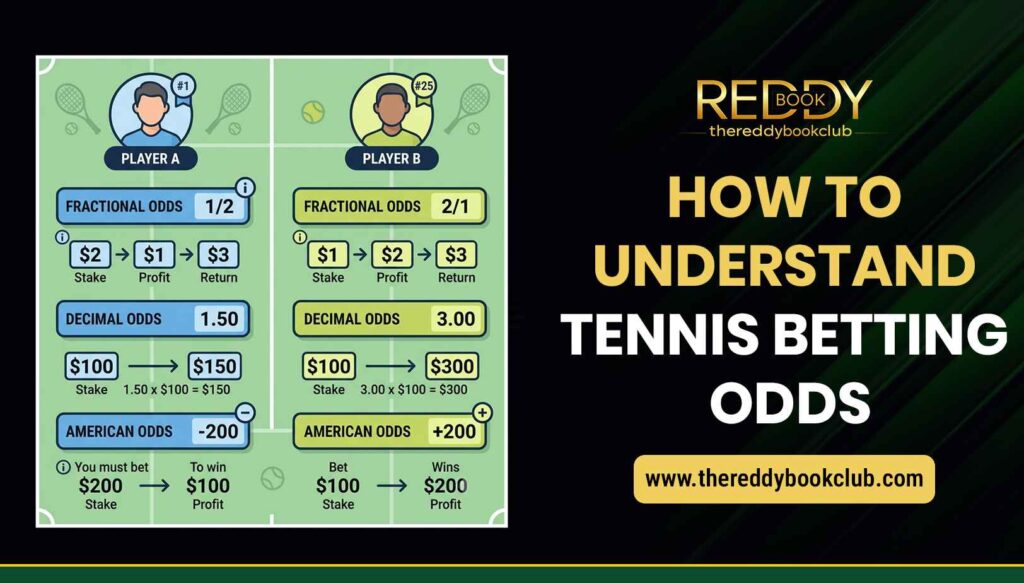
Learning How to Understand Tennis Betting Odds starts with one simple idea: odds are numerical prices associated with selections in a particular market. They do not guarantee what will happen in a match.
This guide explains decimal tennis odds, potential returns, implied probability, bookmaker margin, common tennis markets, odds movement, and the difference between pre-match and live odds. The examples are fictional and are included only to explain how the numbers work.
What Are Tennis Betting Odds?
Tennis betting odds are numerical figures associated with a particular selection in a market.
For example, a fictional match might display:
- Player A — 1.50
- Player B — 2.75
These numbers are the displayed prices for the two selections. They do not guarantee that either player will win.
To understand odds properly, it helps to separate four terms: market, selection, odds, and potential return.
A market describes what is being considered. For example, Match Winner asks which player will win the match.
A selection is one of the available options within that market. In a Match Winner market, Player A and Player B would be selections.
Odds are the numerical prices associated with those selections.
A potential return is the total amount calculated by multiplying a stake by the decimal odds. The actual outcome can still be different because odds are not guarantees.
If you are new to the wider terminology, Tennis Betting Explained: A Beginner’s Guide can provide broader background before you focus specifically on odds.
Decimal Tennis Odds Explained
Decimal odds are one of the simplest formats for understanding tennis prices because the calculation is straightforward.
The basic formula is:
Potential Total Return = Stake × Decimal Odds
Suppose the displayed odds are 2.00 and the fictional stake is ₹100.
The calculation would be:
₹100 × 2.00 = ₹200 total return
That ₹200 is the total return figure under the example.
It includes the original ₹100 stake. Therefore:
- Total return = ₹200
- Original stake = ₹100
- Difference between return and stake = ₹100
Now consider decimal odds of 1.50 with the same ₹100 example:
₹100 × 1.50 = ₹150 total return
This shows why understanding the difference between total return and profit is important. The decimal number applies to the entire stake when calculating the total return.
The same formula can be used with other decimal figures. For example, with odds of 2.50 and a fictional ₹100 stake:
₹100 × 2.50 = ₹250 total return
These examples explain the mathematics only. They do not suggest that one particular price or selection should be chosen.
What Do Low and High Tennis Odds Mean?
One of the first things beginners notice is that some tennis selections have low odds while others have higher odds.
Generally, lower odds correspond to a higher implied probability, while higher odds correspond to a lower implied probability.
For example:
- Player A — 1.40
- Player B — 3.20
The 1.40 price represents a higher implied probability than 3.20.
However, this does not mean that the player with lower odds is guaranteed to win.
A useful distinction is:
Low odds ≠ guaranteed winner
High odds ≠ impossible outcome
The numbers represent market pricing. They should not be treated as certainty about the final result.
Understanding this difference is one of the most important parts of learning How to Understand Tennis Betting Odds.
Understanding Implied Probability From Tennis Odds
Decimal odds can also be converted into an implied probability.
The basic formula is:
Implied Probability = 1 ÷ Decimal Odds × 100
For decimal odds of 2.00:
1 ÷ 2.00 × 100 = 50%
So, 2.00 corresponds to an implied probability of 50%.
For decimal odds of 1.50:
1 ÷ 1.50 × 100 ≈ 66.67%
This percentage represents the probability implied by the displayed odds.
It is important not to confuse implied probability with the actual or guaranteed probability of an event occurring. The odds can include a market margin, meaning the implied probabilities across all available selections may add up to more than 100%.
For example, two selections might individually have implied probabilities that total more than 100%. That does not mean the match has more than a 100% chance of occurring. It reflects the way the market has been priced.
This distinction becomes especially useful when comparing odds with mathematical probability.
If you also read other sports-related odds content, Cricket Betting Odds Explained: How to Read Them can help reinforce the same basic relationship between decimal prices and implied probability.
Tennis Odds and Bookmaker Margin
The bookmaker margin, sometimes called the overround, helps explain why the implied probabilities in a market can add up to more than 100%.
Consider another fictional two-player market:
- Player A: 1.80 → approximately 55.56% implied probability
- Player B: 1.90 → approximately 52.63% implied probability
Adding those percentages gives approximately:
55.56% + 52.63% = 108.19%
The amount above 100% illustrates the market margin in this simplified example.
This is why you should not assume that converting every displayed price into a percentage will produce exactly 100%.
The margin is part of the market’s pricing structure. It also explains why implied probability should be treated as a mathematical interpretation of the odds rather than a statement of the true chance of an outcome.
For beginners, the key point is simple: odds and probability are related, but they are not exactly the same thing.
Common Tennis Betting Markets
Odds only make sense when you know which market they belong to.
A few common tennis markets include the following.
Match Winner
This asks which player will win the match.
For example, Player A and Player B may each have a price in the Match Winner market.
Set Betting
This focuses on the final set score or match score format.
In a best-of-three match, possible scores can include 2–0 and 2–1.
Total Games
This market focuses on the combined number of games played in the match.
A line might be displayed as Over 22.5 or Under 22.5.
Game Handicap
A game handicap adjusts the game total for market purposes.
For example, one selection might be shown at -2.5 games, while another is +2.5 games.
Set Handicap
This applies a similar concept to the number of sets rather than individual games.
Player to Win a Set
This market asks whether a particular player wins at least one set during the match.
The availability of these markets can vary depending on the event and platform. Always check the specific market description and settlement rules rather than assuming that every market works in exactly the same way.
Match Winner Odds: The Simplest Tennis Market
The Match Winner market is one of the easiest places to start when learning tennis odds.
Imagine a fictional market showing:
- Player A — 1.60
- Player B — 2.30
The question being asked is straightforward: Which player wins the match?
Each player has a corresponding decimal price. Those prices can change before or during the match as market information changes.
However, the odds do not mean that Player A will definitely win simply because the displayed number is lower.
The same basic principles apply regardless of the players involved: identify the market, understand the selections, read the decimal prices, and remember that the numbers do not guarantee the result.
Set and Game Handicap Odds Explained
Handicap markets can appear more complicated because they adjust the number of sets or games used for settlement.
A set handicap applies the handicap concept to sets.
A game handicap applies it to games.
For example, a fictional game handicap might show:
Player A -2.5 games
Player B +2.5 games
The final game totals are considered according to the market’s stated settlement rules.
The important point for a beginner is not to assume that a game handicap and set handicap mean the same thing. They refer to different units.
Before interpreting a handicap price, identify whether the handicap applies to games or sets and read the relevant settlement rules.
Over/Under Tennis Games Odds
Total-games markets focus on the combined number of games played by both players.
For example, a market might show:
Over 22.5 games
Under 22.5 games
Consider two fictional match scores.
A result of:
6–4, 6–4
contains 20 games in total.
A result of:
7–6, 6–4
contains 23 games.
The total-games market compares the final number of games with the stated line. A line such as 22.5 creates a numerical threshold that can be compared with the actual total.
Competition format also matters. Different tennis competitions can use different match formats, which can affect the markets that are offered.
The important lesson is to understand exactly what the number represents before interpreting the odds attached to it.
Set Betting and Correct Score Odds
Set betting focuses on the exact set score or match score format rather than simply asking who wins.
For a best-of-three match, possible score formats include:
- 2–0
- 2–1
For a best-of-five match, examples include:
- 3–0
- 3–1
- 3–2
The competition format matters because the number of sets required to win can differ.
This market is therefore different from a simple Match Winner market. Knowing that a player wins the match is not the same as knowing the exact number of sets required to produce the final score.
Always check the competition format and the specific market description before interpreting set-betting odds.
Why Tennis Odds Change Before a Match
Tennis odds can change before a match because market prices respond to changing information and market activity.
Possible factors include:
- Player withdrawals.
- Injury or fitness news.
- Starting announcements where relevant.
- Recent information.
- Market demand.
- Changes in available information.
For example, imagine Player A is initially displayed at:
1.80
Later, the price changes to:
1.65
The numerical price has changed, but that change does not guarantee anything about the eventual match result.
Odds movement should therefore be understood as a change in market pricing, not as a prediction formula.
When learning How to Understand Tennis Betting Odds, it is useful to recognize that odds are not always fixed numbers. They can respond to information and activity before the match begins.
Pre-Match vs Live Tennis Odds
Tennis odds can be displayed before a match or while the match is already underway.
| Pre-Match Odds | Live Odds |
|---|---|
| Available before the match | Available while the match is underway |
| Based on information available before play | Can react to events during the match |
| Usually more stable before major news | Can change rapidly |
| Match has not started | Match is in progress |
Live odds can change after significant match events such as a point, a break of serve, a completed set, an injury, or another important development.
This means live pricing can move much more rapidly than pre-match pricing.
For readers interested in the terminology surrounding live sports information, Reddy Book Live Explained: A Beginner’s Guide provides a separate introduction to that topic.
Tennis Odds and Reddy Book
People researching Reddy Book may also encounter tennis-related terms such as Tennis Betting, Tennis Betting Odds, Sports ID, Reddy Book Live, and different match markets.
It is useful to keep two ideas separate.
Understanding tennis odds is about learning how numerical prices, markets, probability, and settlement rules work.
Understanding a platform or account is a different topic involving terminology, access, and the interface through which information may be displayed.
For broader background, Reddy Book Explained: A Complete Guide for New Users can help explain the terminology around the platform.
The availability of a particular tennis market should not be assumed simply because it is discussed in an educational guide. Markets, prices, and features can vary by platform and event.
Common Mistakes When Reading Tennis Odds
Beginners can make several simple mistakes when first looking at tennis odds.
One common mistake is assuming that low odds guarantee a win. They do not.
Another is treating implied probability as an exact prediction. The percentage calculated from odds is an implied figure and can be affected by market margin.
It is also easy to confuse total return with profit. If ₹100 at 2.00 produces a ₹200 total-return figure, the original ₹100 stake is included in that amount.
Other mistakes include:
- Ignoring the market type.
- Confusing game handicap with set handicap.
- Assuming odds remain fixed.
- Forgetting whether the market is pre-match or live.
- Not checking the specific settlement rules.
The solution is simple: slow down and identify exactly what the market and number represent before interpreting them.
How to Read Tennis Odds Step by Step
If you want a repeatable way to approach tennis odds, use the following process.
Step 1: Identify the Market
First determine whether you are looking at Match Winner, Total Games, Handicap, Set Betting, or another market.
Step 2: Identify the Selections
Understand what each available option represents.
Step 3: Read the Decimal Odds
Look at the displayed decimal number and understand that it represents the price associated with that selection.
Step 4: Calculate the Total Return if Needed
Use:
Stake × Decimal Odds = Potential Total Return
For example, ₹100 at 2.50 gives a mathematical total-return figure of ₹250.
Step 5: Understand Implied Probability
You can use:
1 ÷ Decimal Odds × 100
For example, 2.00 corresponds to an implied probability of 50%.
Step 6: Check the Market Rules
This is particularly important for handicaps, set markets, total games, and live markets.
Step 7: Remember Uncertainty
Odds describe market pricing. They do not guarantee the final result.
This step-by-step approach makes it easier to understand the numbers without treating them as predictions.
Frequently Asked Questions About Tennis Betting Odds
What are tennis betting odds?
Tennis betting odds are numerical prices associated with particular selections within a tennis market. The meaning of the price depends on the market and selection.
How do decimal tennis odds work?
Decimal odds can be used to calculate a potential total return by multiplying the stake by the decimal price.
For example:
₹100 × 2.00 = ₹200 total return
What do low tennis odds mean?
Lower decimal odds generally correspond to a higher implied probability.
That does not mean the outcome is guaranteed.
What do high tennis odds mean?
Higher decimal odds generally correspond to a lower implied probability.
A higher price does not mean an outcome is impossible.
How do I calculate implied probability?
Use:
1 ÷ Decimal Odds × 100
For example, 1.50 gives approximately 66.67%.
Final Checklist for Understanding Tennis Odds
Before interpreting a tennis price, check these points:
- Identify the market.
- Identify the selection.
- Understand the decimal number.
- Know the difference between total return and profit.
- Calculate implied probability carefully.
- Remember that market margin can affect the combined percentages.
- Check whether the odds are pre-match or live.
- Read the settlement rules.
- Never treat odds as guarantees.
- Follow applicable age and legal requirements.
These basic checks can prevent many common misunderstandings.
Final Thoughts
Understanding tennis odds is mainly about learning what the number represents, which market it belongs to, and how the price relates to implied probability.
Once those concepts are clear, terms such as decimal odds, potential return, bookmaker margin, Match Winner, handicaps, Total Games, Set Betting, odds movement, and live pricing become easier to understand.
The most important point is that an odds figure is a market price, not a guarantee of the eventual result.
If you are researching Reddy Book or another platform where tennis-related terminology may appear, understanding the underlying numbers and market types can help you read the information more clearly. Always check the specific market and settlement rules, as well as applicable age and legal requirements.