
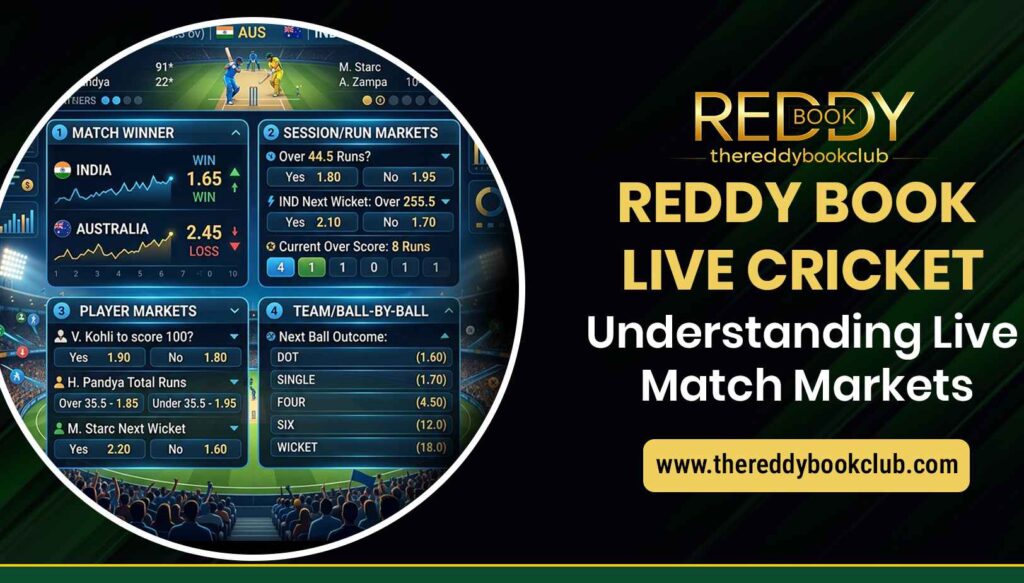
Reddy Book Live Cricket is a useful phrase to understand if you are researching live cricket information and markets. The important point for beginners is to understand what the different numbers, market names, and match situations actually mean rather than reacting simply because something is changing quickly.
Live information can include the score, wickets, overs, player statistics, and other match details. Where live markets are offered, their prices can also change as new information becomes available.
This guide explains how live cricket markets work, why they move, common market types, and the terminology beginners may encounter.
What Does Reddy Book Live Cricket Mean?
The phrase Reddy Book Live Cricket can be understood by separating it into three parts: Reddy Book, live cricket, and live match markets.
“Live cricket” generally refers to information or market activity connected with a match while it is taking place. Instead of looking only at information available before the first ball, users can see information that develops during the game.
Live cricket information may include the current score, number of wickets, overs completed, match status, and player statistics. Where a service provides live markets, users may also see market prices that change during play.
The exact markets, features, terminology, and availability can vary between services. Therefore, it is better to check the current interface and applicable terms of the specific service rather than assuming that every platform offers the same options.
For beginners, the main idea is simple: live markets respond to events happening during the match, while pre-match markets are based on information available before play starts.
Pre-Match Markets vs Live Cricket Markets
A pre-match market exists before the match begins. At that point, there is no live match information to react to, so market expectations are based on information available before play.
This can include the teams involved, players, previous performances, conditions, and other factors relevant to the particular market.
Live cricket markets are different because new information arrives continuously.
Imagine a team begins a match as the stronger side according to the market. If it quickly loses several wickets, the situation can look very different. The market may respond because the information available during the match has changed.
The same can happen when a batting team scores quickly, builds a strong partnership, or has fewer overs remaining than before.
A changing market price represents changing market expectations. It does not guarantee that the expected outcome will happen.
This distinction is important because beginners can sometimes mistake a changing price for certainty. Live markets remain uncertain even when one side appears to have a strong position.
How Live Cricket Markets Change During a Match
Live markets can change because new information becomes available with almost every phase of a cricket match.
Wickets
A wicket can significantly change the expected position of a team. The impact depends on the match situation, the batter involved, the number of wickets already lost, and how much of the innings remains.
Runs and Boundaries
A sequence of boundaries can quickly increase the scoring rate and change how the batting team’s position is viewed. The effect depends on the format, target, overs remaining, and current score.
Overs Remaining
Time matters in cricket. A team chasing a target with many overs remaining has a different situation from one facing the same target with only a few overs left.
Required Run Rate
The required run rate gives a basic indication of how quickly a chasing team needs to score relative to the remaining overs.
For example, needing a certain number of runs with 10 overs available is different from needing the same number with only two overs remaining.
Partnerships
A stable partnership can change the perceived position of the batting side. Conversely, the loss of a key partnership can alter the match situation.
Match Conditions
Pitch behavior, weather, interruptions, and other circumstances can also affect how a live match is viewed.
Because all these factors can change quickly, live markets may also move quickly. Beginners should not feel pressured to react to every change.
Common Live Cricket Markets Beginners May See
The exact markets available depend on the service. Not every platform provides every market, and market names and settlement conditions can differ.
Match Winner
A match-winner market relates to which team is expected to win the match.
During a live match, the market can change as the game develops.
Runs Markets
Some markets relate to team runs or expected scoring outcomes. The exact definition depends on the market rules.
Over Markets
Certain services may provide markets connected with what happens during a particular over or short period of play.
These markets require careful attention because the outcome may relate only to that specific section of the match rather than the entire game.
Wicket-Related Markets
Some services may offer markets connected with wickets or other match events.
The exact conditions should always be checked before interpreting what a market represents.
Player Performance Markets
Depending on the service, markets may relate to measurable player outcomes such as runs or wickets.
A player-related market should not be confused with a match-winner market because the conditions and settlement can be completely different.
Short-Period or Session Markets
Some cricket markets focus on a smaller portion of a match rather than its final result.
The key lesson for beginners is to read the market description carefully. The name alone may not explain every condition that applies.
Understanding Live Cricket Odds
Odds or prices are numerical representations of market expectations and, depending on the format, potential returns.
For decimal odds, the basic calculation for potential total return is:
Potential total return = Stake × Decimal Odds
For example, a ₹100 stake at decimal odds of 2.00 corresponds to a potential total return of ₹200, before considering any applicable rules or deductions.
The ₹200 figure includes the original ₹100 stake. It therefore does not represent a ₹200 profit.
The important point is that odds should not be treated as guaranteed predictions. A price reflects the market at that moment, while the actual match outcome remains uncertain.
In live cricket, odds can change rapidly because the underlying match situation is changing. A wicket, boundary, change in required run rate, or reduction in overs can alter market expectations.
If you are unfamiliar with cricket odds, understanding the difference between a price and a guaranteed outcome is one of the most important concepts to learn.
Why Do Live Cricket Odds Move So Quickly?
Live markets receive new information continuously.
Consider a simple example. A chasing team needs 60 runs from 30 balls. That is a very different situation from needing 60 runs from 60 balls, even though the number of runs required is identical.
Time and match state therefore matter.
Other factors can also influence changing market expectations:
- Wickets
- Boundaries
- Current run rate
- Required run rate
- Overs remaining
- Player availability
- Match interruptions
- Changes in match conditions
This can make live cricket prices move quickly.
For beginners, the important lesson is not to interpret every movement as a signal that an outcome is certain. Rapid movement can make a market difficult to understand, particularly when several match events happen close together.
There is also no requirement to react instantly simply because a price has changed.
Reading the Match Situation Before Looking at a Market
A market number has limited meaning without match context.
Before interpreting a live cricket market, beginners should understand the basic situation:
- Current score
- Wickets lost
- Overs completed
- Overs remaining
- Required run rate
- Current run rate
- Batters at the crease
- Bowling options
- Match format
Consider the difference between a team scoring 80 runs with 15 overs remaining and a team scoring 80 runs with only two overs left. The same score can represent very different situations.
This is why understanding the match itself should come before focusing heavily on changing market prices.
The numbers on a live screen are pieces of information. They need to be understood together rather than viewed in isolation.
Cricket Formats and How Live Markets Can Differ
The format of a cricket match changes its structure, and that affects how live situations develop.
T20
T20 matches have fewer overs, so individual events can have a large impact. A short sequence of wickets or boundaries can quickly change the match.
ODI
One-day international matches have more overs than T20 games, allowing the match to develop over a longer period.
The significance of a particular run rate or score therefore needs to be understood within the longer format.
Test Cricket
Test cricket has a substantially different structure, including multiple innings and much longer timeframes.
A situation that appears significant in a short-format match may have a different meaning in Test cricket.
For this reason, a run rate should never be interpreted without considering the format. The same number can represent different situations depending on how much cricket remains.
Live Cricket Data vs Live Cricket Markets
It is useful to distinguish between live cricket data and a live market.
Live Cricket Data
Live data may include:
- Current score
- Overs
- Wickets
- Player statistics
- Match status
This information tells you what is happening in the match.
Live Market
A live market involves a defined outcome or condition and, where offered, a price that can change during the match.
The difference matters because seeing live match data does not automatically mean that you need to act on a market.
A live score can simply be information. Understanding this distinction can help beginners avoid confusing the match itself with the market attached to it.
What Does “Suspended” Mean in a Live Cricket Market?
A suspended market generally means that activity in that market has been temporarily stopped.
This can happen around significant match events or when the market needs to be updated. For example, a suspension may occur around a wicket, review, interruption, or another event that changes the relevant information.
The exact reason and behavior depend on the service and the rules of the particular market.
A temporary suspension should not automatically be interpreted as a problem with your account.
Live markets need to reflect changing match information, and temporary pauses can occur while information is being processed or the market is recalculated.
If you see a suspended status, check the relevant market information rather than assuming what it means.
Common Mistakes Beginners Make With Live Cricket Markets
One common mistake is reacting to every ball.
Live markets can change frequently, but a changing number does not mean that every movement requires an immediate response.
Another mistake is ignoring the match format. T20, ODI, and Test cricket have different structures, so the same run rate or score can have different meanings.
Looking only at odds is another problem. The current score, wickets, overs, required rate, players involved, and format provide important context.
Beginners should also avoid chasing a previous loss. A losing result does not automatically justify another decision.
Short odds should not be treated as certainty either. Lower odds can still result in a losing outcome.
Finally, acting under pressure can make it harder to evaluate information carefully. Live markets move quickly, but that does not mean you need to rush.
How Responsible Betting Applies to Live Cricket
Live markets can create additional pressure because match events happen quickly.
If you choose to participate in betting where it is legally permitted, it is important to establish personal boundaries before getting caught up in a live match.
These may include setting a personal spending limit and a time limit. Do not increase stakes simply because the market is moving, and do not chase losses after an unsuccessful result.
Taking breaks can also help prevent decisions from becoming purely reactive.
Betting should not be treated as a guaranteed source of income. A live market remains uncertain regardless of how strongly one side appears to be performing.
Age requirements and local laws also matter. Only participate where legally permitted and where you meet the applicable eligibility requirements.
For more context, What Is Responsible Betting? A Practical Guide can help explain the broader idea of setting boundaries and understanding risk.
Reddy Book Live Cricket and Account Safety
Understanding live cricket markets is only part of using an online service safely.
Be cautious about unsolicited messages claiming to provide “live match links,” special market access, urgent account updates, fake support, login links, or market notifications.
Do not assume that a message is legitimate simply because it uses familiar terminology or branding.
When accessing a service, use a trusted route rather than clicking unexpected login links. Keep passwords private and never share one-time authentication codes with another person.
This is particularly important when live events create a sense of urgency. A message telling you that you must act immediately should be independently verified before you provide information.
If you want to learn more about recognizing suspicious messages, see Betting Phishing Scams: How to Recognize the Warning Signs.
A Simple Way to Understand a Live Cricket Market
Beginners can use a simple framework when looking at a live cricket market.
1. Identify the match.
Check which teams are playing and what format the match uses.
2. Check the current situation.
Look at the score, wickets, overs, and required run rate.
3. Identify the market.
Understand exactly what outcome or condition the market represents.
4. Check the terms.
Read the market description and settlement conditions instead of relying only on its title.
5. Do not confuse probability with certainty.
A market price can change, but no price guarantees the final outcome.
This approach keeps the focus on understanding rather than reacting.
Frequently Asked Questions About Reddy Book Live Cricket
What is Reddy Book Live Cricket?
Reddy Book Live Cricket can be understood as a phrase relating to live cricket information and, where offered, live cricket markets. “Live” generally means the information or market is connected to a match while it is taking place.
What are live cricket markets?
Live cricket markets are markets connected to a cricket match while it is in progress. Where offered, their prices can change as new match information becomes available.
Why do live cricket odds change?
Live cricket odds can change because the match situation changes. Wickets, boundaries, run rate, required run rate, overs remaining, player availability, interruptions, and other conditions can affect market expectations.
What does a suspended live cricket market mean?
A suspended market generally means activity has temporarily stopped, often around a significant match event or while information is being updated. The exact reason depends on the service and market rules.
Are live cricket odds guaranteed?
No. Odds represent market expectations or prices at a particular point in time. They do not guarantee the eventual result.
What should beginners check before interpreting a live market?
Check the cricket format, current score, wickets, overs completed, overs remaining, current and required run rates, players involved, the market definition, and applicable rules.
Can live cricket markets differ between platforms?
Yes. Market availability, terminology, conditions, and settlement rules can vary between services. Always check the specific market description rather than assuming that another service uses identical rules.
Final Thoughts: Understanding the Match Comes First
The most important lesson about Reddy Book Live Cricket is that a live market should be understood alongside the actual match situation.
For beginners, learning the terminology is more useful than simply watching prices move. Understand the format, score, wickets, overs, required rate, market definition, and settlement conditions before interpreting a live market.
It is also important not to confuse changing prices with guaranteed outcomes. Live cricket contains uncertainty, and markets can change quickly as new information appears.
Whether you are researching Reddy Book terminology or simply trying to understand live cricket markets, slow down and focus on the information behind the numbers. Live markets should never be treated as guaranteed outcomes or guaranteed income.
Pingback: Cricket Betting Odds Explained: How to Read Them 2026 - thereddybookclub.com