
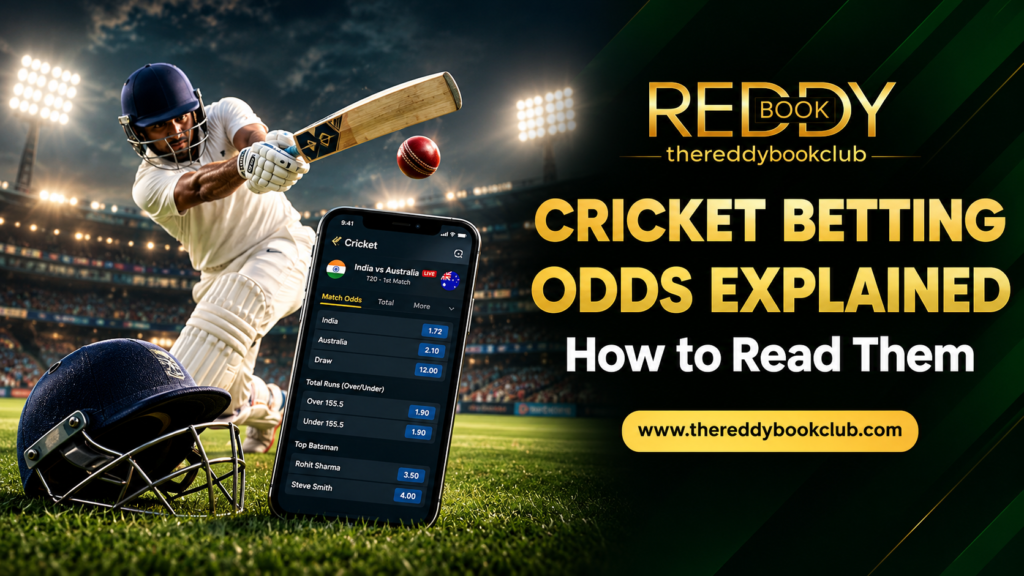
Cricket Betting Odds Explained is a useful starting point for learning how odds express potential returns and implied probability. Odds can be associated with different outcomes, including a team winning a match or a player reaching a particular milestone. However, they do not guarantee that an outcome will happen.
This guide explains decimal odds, implied probability, common cricket markets, and the difference between pre-match and live odds. Readers researching Reddy Book may also find these general concepts useful when learning about cricket-related terminology. The focus here is education, not predicting results or presenting betting as a way to earn money.
What Are Cricket Betting Odds?
Cricket betting odds are numerical figures associated with a particular outcome. Depending on the market, that outcome might be a team winning a match, a player scoring the most runs, or a match total finishing above or below a specified number.
Odds generally communicate two things: the potential return associated with a selection and the implied probability suggested by the quoted price. These concepts are related, but they are not identical.
Lower decimal odds usually correspond to a higher implied probability, while higher odds usually correspond to a lower implied probability. This relationship describes how the outcome is priced, not what will definitely happen during a match.
For example, odds of 1.50 suggest a higher implied probability than odds of 3.00. However, neither figure guarantees that the associated outcome will occur.
Decimal odds are commonly used because they make potential-return calculations relatively straightforward. By multiplying the stake by the decimal odds, it is possible to calculate the gross return for a winning selection under standard rules.
Understanding this calculation is only one part of interpreting a market. The exact outcome, settlement conditions, and any applicable deductions also matter.
Understanding Decimal Odds With Simple Examples
Decimal odds show the gross return for each unit of stake if a selection wins, subject to the market’s rules and any applicable conditions.
Consider a hypothetical example involving a ₹100 stake at decimal odds of 2.50. Multiplying ₹100 by 2.50 gives a potential gross return of ₹250. This includes the original ₹100 stake, so the potential profit would be ₹150 before any applicable fees, deductions, or special conditions.
The formula is:
Potential gross return = stake × decimal odds
The following examples show how the calculation changes with different decimal odds.
| Decimal odds | Hypothetical stake | Potential gross return | Potential profit |
|---|---|---|---|
| 1.50 | ₹100 | ₹150 | ₹50 |
| 2.00 | ₹100 | ₹200 | ₹100 |
| 3.00 | ₹100 | ₹300 | ₹200 |
These figures are mathematical examples, not recommendations or predictions. The calculation describes what the return would be if the selection won under the stated conditions.
It is important to distinguish gross return from profit. Gross return includes the original stake, whereas profit is the amount remaining after subtracting the original stake from the gross return.
Higher odds can produce a larger potential return for the same stake, but they do not guarantee a better outcome. The associated uncertainty and the precise market rules still need to be understood.
How to Calculate Implied Probability From Odds
Implied probability is the probability suggested by a set of odds. It is a mathematical conversion rather than confirmation of the true chance that an event will occur.
For decimal odds, the basic formula is:
[
\text{Implied probability (%)}=\frac{1}{\text{Decimal odds}}\times100
]
Suppose the decimal odds are 2.00. Dividing 1 by 2.00 gives 0.50. Multiplying this by 100 produces an implied probability of 50%.
At decimal odds of 4.00, the same calculation gives 25%.
These calculations help explain the relationship between odds and implied probability. Lower odds produce a higher implied probability, while higher odds produce a lower implied probability.
However, the result should not be treated as a verified forecast. Quoted odds may include a margin for the provider, and the market price may not accurately represent the actual probability of the outcome.
When a market contains several possible outcomes, the implied probabilities calculated from the quoted odds may add up to more than 100%. This can happen because of the margin built into the prices.
For beginners, the main lesson is to understand what the calculation represents and what it does not. An implied probability is derived from odds; it does not make a sporting result certain.
What Do Low and High Cricket Odds Mean?
Low and high odds describe different prices associated with possible outcomes. In general, lower odds correspond to a higher implied probability, while higher odds correspond to a lower implied probability.
Imagine a hypothetical cricket match in which one team has decimal odds of 1.60 and the other has odds of 2.80. The lower price indicates that the market assigns a higher implied probability to the first team’s outcome. It does not establish that the team will win.
People sometimes describe the outcome with lower odds as the favourite and the outcome with higher odds as the underdog. These labels describe how the outcomes are priced in that market, rather than confirming their eventual results.
Odds alone also do not explain every factor affecting a cricket match. Player availability, pitch conditions, weather, team selection, and the match situation can all be relevant to how an outcome is assessed or priced.
It is therefore a mistake to assume that a low-odds outcome is certain or that a high-odds outcome automatically represents good value.
Understanding the relationship between price and implied probability helps readers interpret figures more accurately. It does not provide a reliable way to predict the result of a match.
Common Cricket Betting Markets and Their Odds
Odds can apply to many different cricket markets. Before interpreting a price, it is important to understand exactly which outcome the market describes and how the result will be settled.
Common market labels include the following:
Match winner: Concerns which team wins the match, subject to the market’s settlement rules. Those rules may specify how a tie, abandoned match, or other unusual result is handled.
Toss winner: Concerns which team wins the toss. The toss result is separate from the match result and does not establish which team will win the game.
Top batter: Relates to the player who scores the most runs under the stated conditions. The rules may specify how ties or players with equal scores are handled.
Top bowler: Relates to a bowling-performance outcome, with settlement determined by the specific market rules.
Total runs: Concerns a team’s or match’s total score. Some markets compare the final total with a specified line.
Over/under markets: Compare a defined statistic with a listed number. The market rules determine what counts toward the total and how the final result is settled.
Live markets: Display odds while a match is underway. Their prices may change as the game develops, and some markets may be temporarily suspended.
Not every provider offers every market. Labels, availability, and settlement conditions can differ, so a familiar market name should not replace reading its full description.
For broader background on cricket market terminology, see Cricket Betting Explained: A Beginner’s Guide to Common Markets.
How Cricket Format Can Affect Odds
Cricket is played in several formats, including Test matches, One Day Internationals (ODIs), and Twenty20 (T20). Each format has different match durations and scoring patterns, which can affect the types of outcomes considered in a market.
Test matches can continue over several days, and the match situation may change substantially over time. Factors such as the state of the pitch, weather interruptions, and remaining playing time can be important when interpreting a Test match result.
ODIs use a limited number of overs per team and generally provide a different scoring context from Test cricket. T20 matches have fewer overs, so scoring and changes in the match situation can occur over a shorter period.
The same team may have different quoted odds across formats or under different match conditions. Player availability, the selected playing XI, pitch conditions, weather, and toss results may all be relevant to how a market is priced.
However, these factors do not make the outcome certain. Even detailed information about a team or match cannot remove the uncertainty associated with sporting events.
When reading a market, it is useful to understand the format and the conditions relevant to that particular match. Avoid treating a team’s past performance in one format as a guarantee of how it will perform in another.
Understanding Live Cricket Betting Odds
Live or in-play odds are displayed while a cricket match is underway. Unlike pre-match odds, they can change as new information about the match becomes available.
A wicket, boundary, change in run rate, developing partnership, or interruption can affect how the remaining match is assessed. For example, in a hypothetical match, a team might lose an important batter while chasing a target. The quoted odds for the match result may then change because the match situation has changed.
This is an explanation of how prices can respond to events, not a prediction about any real match.
Live odds can update quickly, and the market may be suspended temporarily while an event is assessed or the information is updated. A price displayed on a screen does not necessarily mean that a selection will be accepted at that exact price or that its final settlement is already known.
Readers should understand the market rules and avoid making rushed decisions based on a single ball, boundary, or wicket. Fast-changing prices can be difficult to interpret, particularly when several aspects of the match are developing at once.
For readers exploring live-match terminology, Reddy Book Live Cricket: Understanding Live Match Markets is a relevant related topic. Confirm the article’s published URL before adding it as a clickable link.
Pre-Match Odds vs. Live Odds
Pre-match odds are displayed before a match begins. Live odds are displayed while the match is in progress. Both describe prices associated with possible outcomes, but the information available at each stage can differ.
Before a match, market prices may reflect factors such as team news, player availability, expected conditions, and other information available before play begins.
During the match, prices may change in response to the score, wickets, overs remaining, run rate, interruptions, and other developments. Some markets may also be suspended temporarily.
| Feature | Pre-match odds | Live odds |
|---|---|---|
| Timing | Before play begins | During the match |
| Relevant information | Team news and pre-match conditions | Score and match developments |
| Price changes | May change before the start | Can change frequently during play |
| Important consideration | Check the market rules before the event | Understand that conditions can change quickly |
Neither format makes every result predictable. Pre-match information may be incomplete, while live information describes a match that is still developing.
The distinction is mainly about timing and the information available when the price is displayed. In both cases, readers should check the market description and avoid confusing an implied probability with certainty.
Common Mistakes When Reading Cricket Odds
Several common mistakes can lead to misunderstandings when interpreting odds.
One is confusing potential gross return with profit. If ₹100 is placed at decimal odds of 2.00, the gross return for a winning selection would be ₹200 under standard rules, including the original stake. The potential profit would be ₹100 before applicable deductions or conditions.
Another mistake is assuming that lower odds guarantee a win. Lower odds generally indicate a higher implied probability, but the event can still produce a different result.
Readers may also treat implied probability as a verified prediction. It is a calculation based on the quoted odds and may not represent the true chance of the outcome.
Ignoring settlement rules can cause confusion too. A market may have specific conditions for ties, abandoned matches, player retirements, or other unusual circumstances.
Live prices can change or markets can be suspended, so a displayed figure should not automatically be treated as final. Past match results also do not determine the next result.
Finally, rushed decisions after a wicket or boundary can make it harder to assess information calmly. Understanding the calculation and reading the relevant rules are more useful than reacting to every change in price.
Understanding Cricket Odds When Researching Reddy Book
People researching Reddy Book may encounter cricket-related terms, odds, and market descriptions while exploring the broader subject. Understanding those terms is separate from verifying a particular website, service, or account.
A displayed price does not prove that a service is legitimate, and the appearance of an odds format does not establish which features a particular provider offers. Services can differ in market availability, rules, terms, and account procedures.
Before sharing personal information or using a service, verify its identity through reliable sources. Review the applicable terms, privacy practices, support information, and legal requirements in your location.
It is also important to understand the conditions attached to any market. Even if a description looks familiar, the settlement rules may differ between providers.
For a general introduction to the topic, read Reddy Book Explained: A Complete Guide for New Users.
Keep the distinction clear: understanding cricket odds helps explain how prices and potential returns are presented. It does not verify a service’s legitimacy, guarantee an outcome, or remove the financial risks associated with betting.
Responsible Betting and Online Account Safety
Odds describe prices and implied probabilities; they should not be treated as a reliable source of income. Betting can result in financial losses, even when someone understands the calculations and market terminology.
Never use borrowed money or funds needed for essential expenses. Chasing losses or increasing stakes in an attempt to recover money can make financial harm worse. Setting clear personal limits and stopping when those limits are reached can help prevent spending from escalating.
If betting becomes stressful, interferes with daily responsibilities, or feels difficult to control, consider taking a break or stopping. Support from a trusted person or an appropriate local service may be helpful.
Online safety is important as well. Use strong, unique passwords, check website addresses before entering credentials, and never share passwords or one-time passcodes. Be cautious with unsolicited links and messages.
For practical security guidance, read How to Protect Your Online Betting Account.
Laws and age restrictions relating to online betting vary by location. Check the requirements that apply to you before using any related service.
Frequently Asked Questions
What are cricket betting odds?
They are numerical prices associated with a particular outcome. Odds can be used to calculate a potential gross return and an implied probability, but they do not guarantee that the outcome will happen.
How do you read decimal cricket odds?
Multiply the stake by the decimal odds to calculate the potential gross return for a winning selection under standard rules. The gross return includes the original stake, while profit is the amount remaining after subtracting that stake.
Do lower odds mean a team will definitely win?
No. Lower odds generally correspond to a higher implied probability, but the result remains uncertain. A price should not be interpreted as a guarantee.
What do odds of 2.00 mean?
At decimal odds of 2.00, a hypothetical ₹100 winning stake would produce a gross return of ₹200 under standard rules, including the original stake. The potential profit would be ₹100 before applicable deductions or conditions.
Why do live cricket odds change?
They may change as wickets fall, runs are scored, the required run rate changes, or other match conditions develop. Markets can also be suspended temporarily.
Are cricket odds the same across every platform?
No. Prices, market availability, rules, and settlement conditions can differ between providers. Readers should check the specific market rather than assuming that every service uses identical terms.
Conclusion: Read Cricket Odds With Greater Understanding
Cricket Betting Odds Explained brings together several important concepts: decimal odds, implied probability, potential returns, common cricket markets, and the difference between pre-match and live prices. Understanding these ideas can make cricket-related terminology easier to interpret. However, odds describe prices and implied probabilities rather than certain outcomes. Always check market rules, distinguish gross return from profit, and consider the financial risks. If researching Reddy Book or another service, verify its identity and applicable legal requirements before making decisions.